The stain shows up on the ceiling after a wet week. You get up into the roof space with a torch, expecting to find a hole right above it, and there is nothing. Just dry timber and a trail of water marks running off somewhere into the dark. That is the most common start to a metal roof leak repair job we get called to around Nowra, and it is why so many leaks get “fixed” two or three times before they actually stop.
Metal roofs are good at shedding water. When they leak, it is almost always at a joint, a fixing or a patch of rust, not through the middle of a healthy sheet. The trick is finding which one.
The leak is rarely where the stain is
Water that gets under a metal sheet does not drop straight down. It runs along the underside of the ribs, follows a batten or a rafter, and only lets go when it meets something that tips it off. On a low pitch roof it can travel a surprising distance before it reaches the ceiling.
If the roof has sarking (the foil blanket laid under the sheets), the water can ride along that too and come out at a tear or a join metres away. So the first job is to trace it back. We look from inside the roof space first, then from the top, and only then decide what needs fixing.
Where metal roofs actually let water in
Most of the metal roofs we look at around Nowra leak in one of five places. Some have more than one going at once, which is part of why a single patch often does not solve it.
Roof screws and their washers
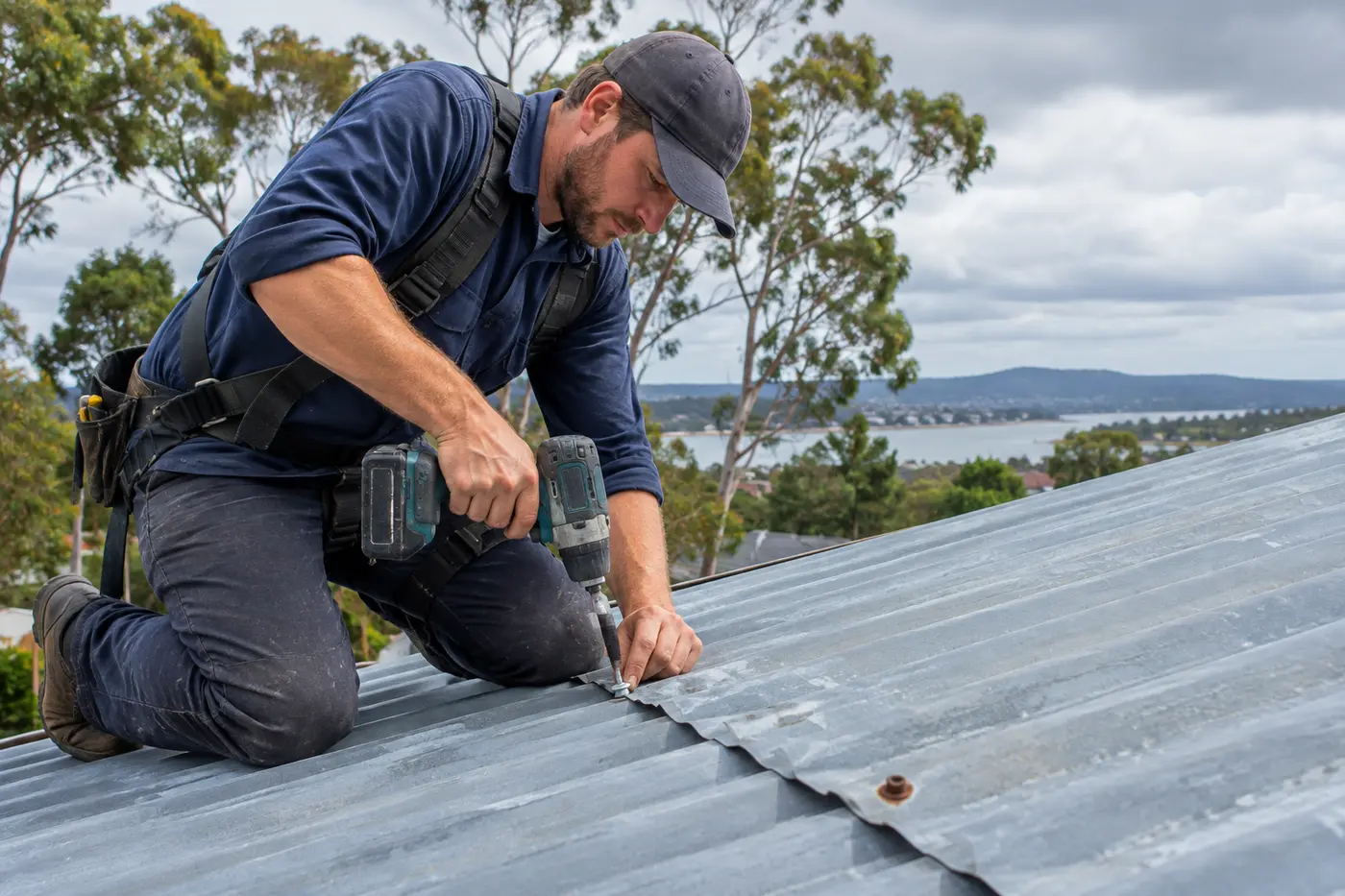
Every screw through a metal sheet has a rubber washer under its head. Over years in the sun those washers harden, crack and shrink. Screws also back out a little as the timber underneath dries and moves. Either way you end up with a small gap around the screw that lets water wick straight through. Screws that were overdriven when the roof went on can crush the washer from day one, and screws fixed through the pans (the flat channels water runs along) rather than the ribs sit in running water every time it rains.
Side laps and end laps
Where two sheets overlap, water can be drawn sideways into the joint by capillary action, the same pull that draws water up a paper towel. It is worst on low pitch roofs and on laps that were never fixed tightly. You often see it as a neat line of drips along one rafter.
Flashings
Flashings are the folded metal pieces that seal the roof to walls, chimneys, skylights and vents. When the sealant behind them perishes, or the flashing lifts in wind, water gets in at the edge. We cover the reseal, repair or replace choice in more detail in our post on fixing roof flashings that have started to leak.
Rust
Rust usually starts in the spots that stay wet longest: the bottom edge of sheets above the gutter, around old screw holes, under overhanging trees, and anywhere a previous tradie left swarf (the tiny metal filings from cutting) lying on the roof. On homes closer to the coast, salt in the air speeds all of this up. Surface rust is a warning. Rust you can push a screwdriver through is a hole.
Gutters and box gutters
Sometimes the roof is fine and the water is coming back in from a gutter that overflows inward or a box gutter that cannot drain fast enough. These leaks tend to show up in the heaviest rain only, which is a useful clue. If yours only drips in a downpour, our guide to leaks that only appear in heavy rain walks through that pattern.
One more that catches people out: condensation. Warm, moist air from inside the house can condense on the cold underside of a metal roof on a winter night and drip onto the ceiling. It looks like a leak, but no amount of sealant on the outside will stop it.
Silicone on top is a patch, not a repair
The most common thing we find on a leaking metal roof is somebody else’s attempt to seal it. A blob of silicone over a screw head. A smear along a lap. A strip of tape over a rust hole.
These can buy you a few dry weeks. They rarely last, because they treat the symptom and leave the cause. Sealant over a loose screw cracks as soon as the screw moves again. Tape over rust traps moisture and lets the rust keep spreading underneath it. And a roof covered in old sealant makes the real source harder to find next time.
That is not to say sealant has no place. A good roof sealant has a job behind a flashing or in a joint designed for it. It just should not be the whole fix.
What a proper fix looks like
The repair depends on what we find, but the usual ones are straightforward:
- Worn screws replaced with new screws and fresh washers, going up a size where the old hole has worn oversized
- Laps refixed and sealed properly so the joint closes up
- Lifted or perished flashings refixed, resealed or replaced
- Rusted sheets cut out and replaced, rather than patched over
- Gutters and outlets cleared or reworked so water leaves the roof instead of backing up
Often the screws on one section are failing while the rest of the roof is sound, so a targeted rescrew is all it takes. Other times the rust or wear is spread across the whole roof, and you are better off knowing that before you spend money on patch after patch. You can see the full range of work on our metal roof repairs page.
We will tell you if the cheaper fix is the right one
Ryan Bruce leads the team, with more than 10 years of roofing experience behind the work, and we are fully licensed and insured. Our approach does not change from job to job. Look at the roof properly, explain what we found in plain English, price the job in writing, and tell you when the cheaper option is the right one.
For a lot of metal roofs, that cheaper option is genuinely a handful of screws and a resealed flashing. For an older roof where rust has taken hold across many sheets, we will say so, and show you what we saw so you can make the call yourself.
What to do while you wait
Put a bucket under the drip and move anything valuable out of the way. If water is pooling on the ceiling or the plaster is sagging, keep people out from under it and turn off any light fitting nearby.
Take photos of the stain and note when it leaks: every rain, only heavy rain, only with wind from one direction, or only on cold mornings. That pattern helps us find the source faster.
Please do not climb up on a wet metal roof to look. It is slippery even when dry, and the damage is never worth a fall.
Common questions about metal roof leaks
What is the most common cause of metal roof leaks?
On the roofs we see, it is worn or loose roof screws. The rubber washers perish with age and the screws work loose as the timber moves. Laps, flashings and rust follow close behind.
What should I put on a leaking metal roof?
As a short term measure, very little. Sealant or tape over the spot you think is leaking usually does not reach the real cause and can hide it. The lasting fix is to replace the failed part, whether that is a screw, a flashing or a rusted sheet.
Do metal roofs need to be resealed?
Not the whole roof as a routine job. The sheets themselves are not sealed. What needs attention over time are the screws, the flashing seals and any joints, which can be refixed or resealed as they wear.
How can I waterproof an old corrugated iron roof?
Start by fixing what is already letting water in: screws, laps, flashings and rust holes. Once the roof is sound, a restoration with the right coating can extend its life. If the iron is rusted through in many places, replacing those sheets or the whole roof is the more honest answer.
How much does it cost to fix a leaking metal roof?
It depends entirely on the cause and how far it has spread. A few screws on one section is a very different job to replacing rusted sheets. We come and look, explain what we find and give you a free written quote before any work starts.
Why does my metal roof only drip on cold mornings?
That is often condensation rather than a leak. Moist air inside the roof space condenses on the cold metal overnight and drips down. The fix is usually about ventilation and insulation, not sealing the outside.
Get the leak found, not just covered
If your metal or Colorbond roof is leaking and you are tired of patches that do not hold, we can help. We will trace the leak to its source and give you a free written quote for a proper metal roof leak repair, anywhere around Nowra and the Shoalhaven.