It has been pouring for two days, the kind of steady, sideways rain the Shoalhaven gets when a low sits off the coast. Then you notice a brown ring on the hallway ceiling, or a drip landing on the laundry floor. The strange part is that the roof has been through dozens of ordinary showers without a drop getting in. If your roof is leaking in heavy rain but stays dry the rest of the time, that pattern is a useful clue. It tells us a lot about where the water is getting in.
We get these calls across Nowra after every big downpour. This post covers what to do on the day, why a roof can hold up in light rain and fail in a storm, and how we track the leak down once the weather clears.
First, protect the inside of the house
Nobody should be on a roof in the rain. Wet tiles and wet metal are slippery, and a fall from a single storey can be serious. Everything useful you can do during the storm happens inside.
- Put a bucket or tub under the drip, with an old towel in it to stop the splashing.
- If water is coming through near a light fitting, downlight or power point, turn that circuit off at the switchboard and leave it off until an electrician has checked it.
- Move furniture, rugs and electronics out of the way.
- If a patch of plasterboard is sagging and full of water, a small hole at the lowest point lets it drain into a bucket rather than letting the sheet collapse.
- Take photos of the ceiling, the drip and anything that got wet. You will want them for the repair, and for your insurer if you make a claim.
One more thing helps us a lot: note where the water shows up and roughly when it started. “Only after about six hours of heavy rain, only when the wind came from the south” is exactly the kind of detail a roofer wants to hear.
Why a roof copes with showers but leaks in a downpour
A roof does not have to be watertight like a boat. Tiles and metal sheets overlap so water runs down and off before it can find a way in. That works fine at normal volumes. Heavy rain changes two things: how much water arrives at once, and the angle it arrives at. Most leaks that only appear in storms come from one of the causes below.
Gutters and downpipes that cannot keep up
This is the one we find most often. When a gutter is partly blocked with leaves, or there are too few downpipes for the size of the roof, water backs up and spills over the back edge of the gutter. From there it runs into the eaves or down inside the wall. In light rain the gutter drains fast enough and you never see a problem. Homes around Cambewarra, Falls Creek and anywhere with big gums nearby tend to fill their gutters faster than people expect. We have written more about this in our post on how damaged gutters let water into a home.
Valleys that overflow
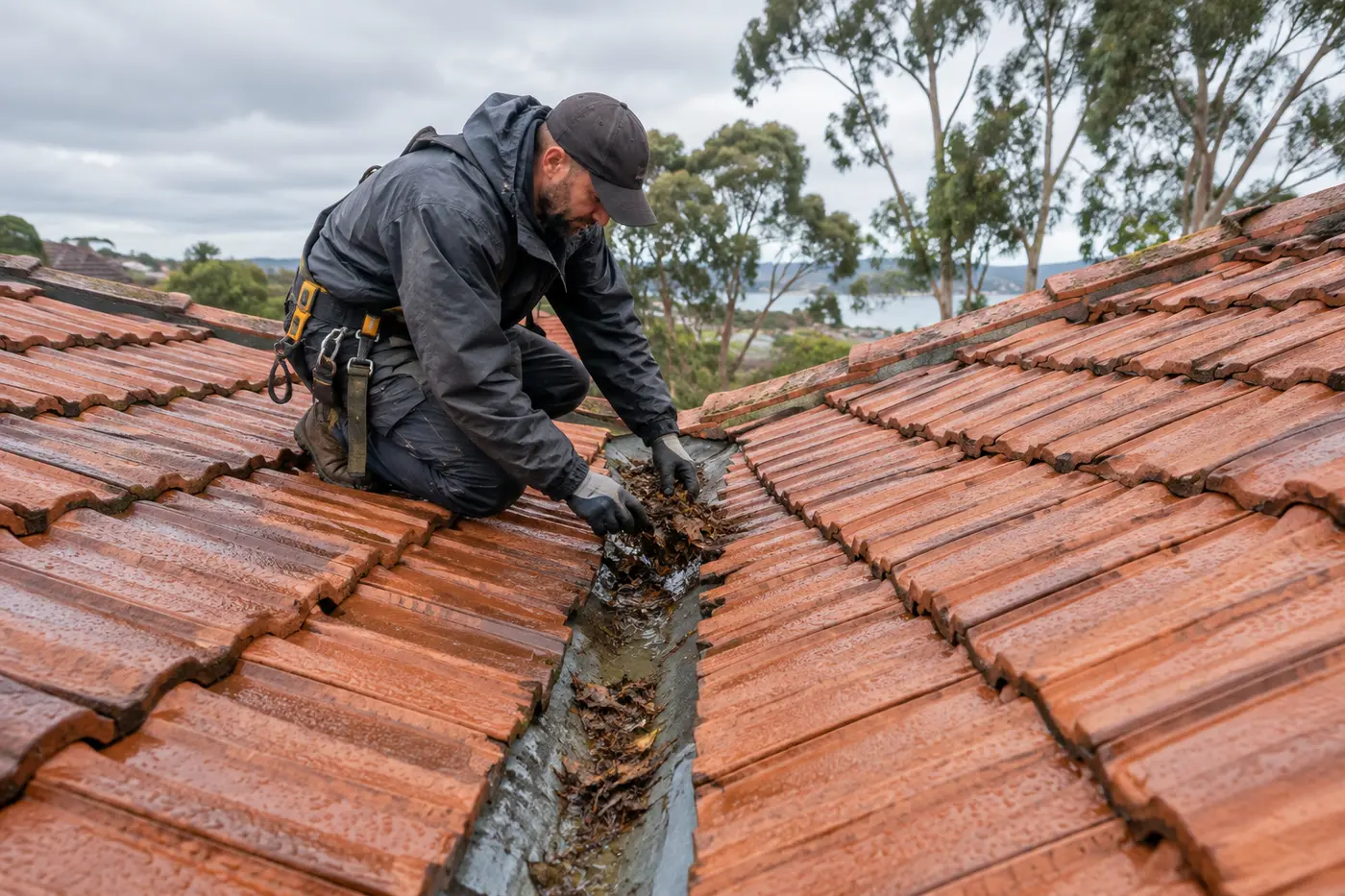
A valley is the metal channel where two roof slopes meet. It carries water from both slopes, so in a storm it handles far more water than any other part of the roof. If leaves and tile grit build up in it, or the tiles either side sit too low, water spills over the edges of the channel and under the tiles. Old valley irons also rust through, often in spots you cannot see from the ground. When the valley itself is worn out, patching rarely lasts and replacing the valley iron is usually the lasting fix.
Wind pushing water sideways
Rain falling straight down runs off overlapping tiles easily. Rain driven by a strong wind can be pushed uphill, under the lap of a tile or sheet, past the point where it would normally drain away. Ridge capping (the row of curved tiles along the top of the roof) is especially exposed. If the mortar holding it has cracked or come away, wind blown rain gets straight underneath. This is where pointing, the flexible compound that seals the ridge caps in place, earns its keep.
Flashings and anything that goes through the roof
Flashing is the folded metal strip that seals the join between the roof and something else: a wall, a chimney, a skylight or a vent pipe. Over the years the sealant dries out, the metal lifts, or the flashing was never turned up high enough behind the wall in the first place. A small gap might shed a light shower, then let a lot in once water is running across the roof in sheets.
Cracked, slipped or lifted tiles and sheets
A tile with a hairline crack, or one that has slipped a few centimetres, may only let water in once there is enough flowing down the slope. On metal roofs we look for screws that have loosened or whose rubber washers have perished, and for sheet laps near the coast that have started to rust. In salt air areas like Culburra Beach and Shoalhaven Heads, we check the corrosion around fixings on every metal roof we inspect.
The drip is rarely under the hole
This catches a lot of people out. Water that gets past the roof covering usually lands on the sarking (the foil or membrane under the tiles), a batten or a rafter, and travels along it before dropping onto the ceiling. We have traced leaks that showed up a couple of metres from where they started. That is why replacing the tile directly above the stain and hoping for the best often ends with the same stain after the next storm.
When we look at a leak, we start inside with the stain and your notes about wind and timing. Next we go into the roof space, if it can be reached, and look for water marks, damp timber and daylight. Then we get up on the roof and work uphill from the wet area, checking gutters, valleys, flashings, ridges and the tiles or sheets themselves. Where the source is not obvious, running a hose over one section of roof at a time usually settles it. Once we know the cause, we explain it in plain English and give you a written quote that spells out what is and is not included.
For a sense of the fixes involved, from a single cracked tile through to flashings and ridge work, our roof repair service page walks through the work we do on tile and metal roofs around Nowra.
Waiting for the next dry spell is the expensive option
A leak that only turns up in storms is easy to put off, because most weeks it is not a problem. The trouble is what happens in between. Wet insulation stops working and can stay damp for a long time. Ceiling plasterboard softens, stains and eventually sags. Timber battens and rafters that keep getting wet start to rot, and mould can grow in the roof space where you will not see it. Every heavy rain adds to the damage, so a job that could have been a few tiles and some sealant turns into ceiling work as well.
If your home is insured, read your policy soon after you notice the leak. Insurers usually treat sudden storm damage differently from gradual wear, and many expect you to take reasonable steps to stop further damage once you know about a problem. Your photos and a written report from the roofer both help.
Common questions about roofs leaking in heavy rain
Why does my roof leak only when it rains hard?
Heavy rain brings more water and often more wind. Gutters and valleys that cope with a shower overflow in a downpour, and wind can push water sideways under tiles, ridge caps and flashings. The roof may have a weak spot that only gets tested once water is running across it in volume.
What should I do if my roof leaks during heavy rain?
Stay off the roof. Catch the water, move your belongings, switch off power to any circuit where water is near a light or outlet, and take photos. Then book a roofer to find the source once the rain stops.
When should I worry about a roof leak?
Straight away if water is near electrics, if the ceiling is sagging, or if the leak gets bigger with each storm. Even a small, occasional drip is worth having checked, because damage inside the roof space builds up long before it shows on the ceiling.
Is it expensive to fix a roof leak?
It depends entirely on the cause. A cracked tile or a blocked gutter is a small job, while a rusted valley or a failed flashing along a wall is more work. We give a free written quote after finding the source, so you know the cost before anything starts.
Will insurance pay for a leaky roof?
Many policies cover sudden storm damage but not leaks caused by wear and tear or lack of maintenance. Every policy is different, so check yours and talk to your insurer early. Photos and a roofer’s report on the cause make that conversation much easier.
Can a roofer find a leak when it isn’t raining?
Usually, yes. Water stains in the roof space, rusted metal, cracked mortar and slipped tiles are all visible in dry weather. If the source is still unclear, we run a hose over sections of the roof to recreate the leak.
Get the leak found before the next storm
If a new stain has appeared on your ceiling after heavy rain, call us on (02) 4409 2597. Ryan Bruce leads the team, we have more than 10 years of roofing experience behind the work, and we are fully licensed and insured. We will tell you plainly what we find and what it will take to fix. You can read more about our leak and roof repair work around Nowra, or get in touch for a free written quote.