The stain on the ceiling is right next to where the roof meets a wall. Or it shows up under the skylight, or around the bathroom exhaust vent, and only after a southerly drives the rain sideways. Most of the time that pattern points to one thing: the flashing. Roof flashing repair is one of the most common jobs we do around Nowra, and it is also one of the most commonly botched, usually with a tube of silicone and a ladder.
Here is what flashing actually does, how it fails, and how to tell if yours needs a reseal, a repair or a full replacement.
Flashing is the weak point on almost every roof
Flashing is the strip of metal or flexible material that seals a join. Anywhere the roof stops being one continuous surface, there is flashing: where it meets a wall, around a chimney, a skylight or a vent pipe, along the valleys where two roof slopes meet, and at the edges.
Tiles and metal sheets shed water well on their own. The joins are where they need help. A roof can have perfectly sound tiles and still leak for years because one short run of flashing beside a wall has lifted.
On the homes we look at, flashing usually turns up in a few forms:
- Lead flashing, dressed over tiles at walls and chimneys on older homes
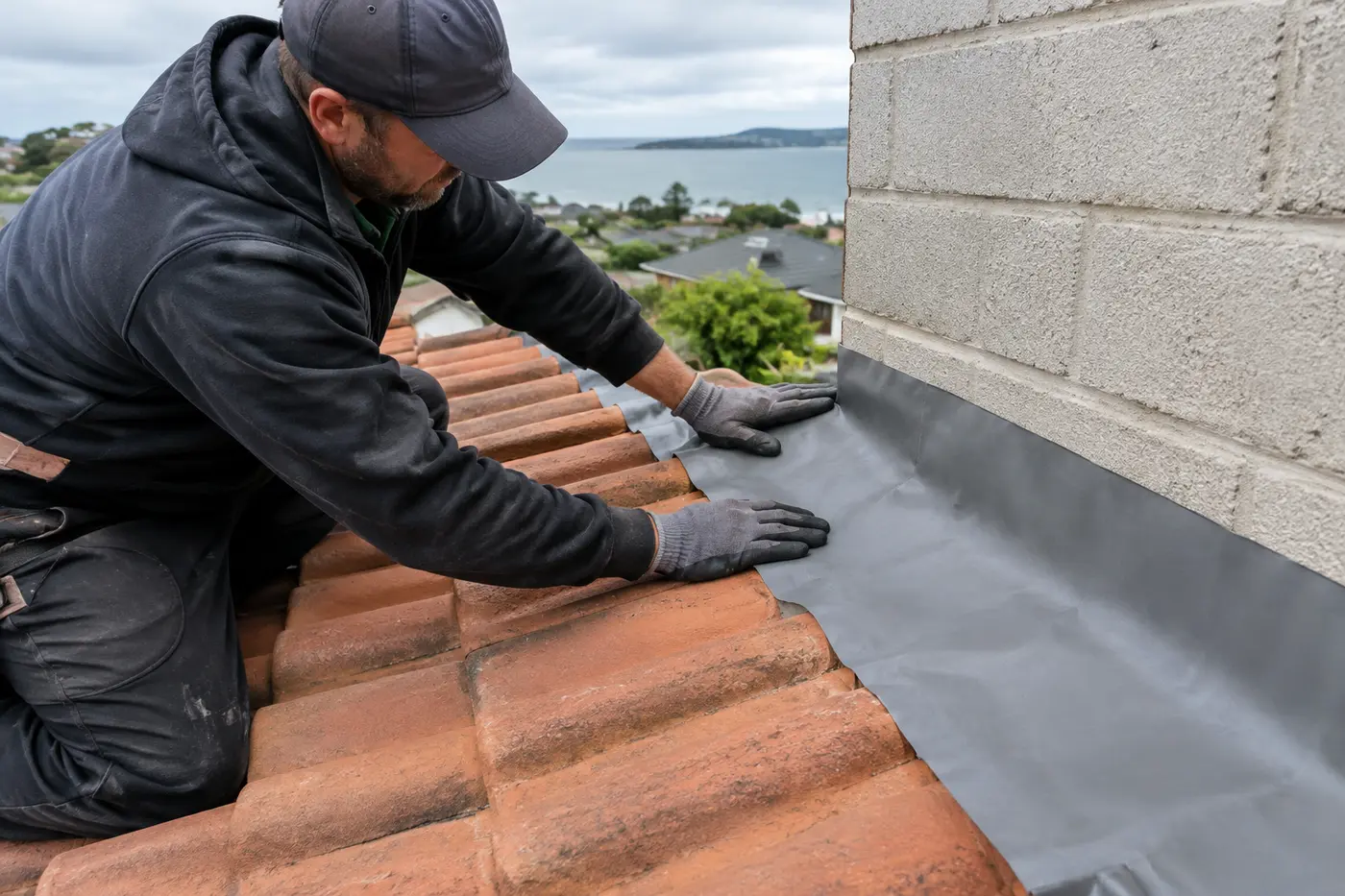
- Flexible lead-free flashing (an aluminium mesh coated in rubber), common on newer tile roofs
- Pressed steel flashing, Colorbond or Zincalume, on metal roofs and around penetrations
- Rubber boots around round vent pipes
- Mortar standing in for flashing at wall junctions on some older tile roofs
That last one is worth knowing about. Mortar was never a great flashing. It cracks as the house moves, and once it cracks it funnels water straight in behind the tiles.
How flashing fails, and what it looks like from inside
Flashing rarely fails all at once. It wears out at its fixings and seals first. These are the faults we find most often.
Sealant that has given up. Silicone and roofing sealants harden and shrink in the sun. After a few summers they pull away from the wall, and the gap is often impossible to see from the gutter line.
Flashing that has lifted. Wind gets under a loose edge and bends it up a little more each storm. Eventually rain blows straight under it. Lead and flexible flashing are soft enough that this happens easily if they were not dressed down properly in the first place.
Rust. Steel flashing rusts from the cut edges and fixings first. Closer to the coast, around Culburra Beach and Shoalhaven Heads, salt air speeds this up, and we see flashings rust through well before the main roof sheets do.
Cracked vent boots. The rubber collar around a vent pipe perishes in UV. It splits on the sunny side, and the leak shows up on the ceiling directly below.
Bad original work. This one surprises people. A good share of the flashing leaks we chase were never right to begin with: flashing too narrow to cover the gap, no turn-up against the wall, or sealant doing a job that should have been done by shaping the metal.
Flashing leaks have a giveaway. They show up near a wall, a chimney or a penetration, not in the middle of a room, and they are often worse in wind-driven rain than in heavy rain falling straight down. If your leak only appears in storms, our post on why roofs leak in heavy rain walks through the other likely culprits too.
Reseal, repair or replace: how we decide
Not every flashing problem needs new flashing. We work through it in roughly this order.
A reseal is fine when the metal is sound
If the flashing still sits flat, has no rust holes and is the right size for the job, cleaning it back and running a fresh bead of quality sealant is a legitimate fix. It is quick and it is the cheapest option. What it is not is permanent. Sealant is a maintenance item, and it will need doing again.
A repair suits one damaged section
If one length of flashing has lifted or one vent boot has split, we replace that section and leave the rest alone. Dressing lead back down, refixing a loose run or fitting a new boot over a vent pipe all fall in here.
Replacement is the honest answer when the flashing was the problem all along
We recommend new flashing when the old one has rusted through, when it is mortar doing a flashing’s job, or when it was the wrong size or shape from day one. Gluing a patch onto flashing like that just schedules the next leak. New flashing is cut and folded to fit the joint so the metal sheds the water, with sealant only as a backup.
If you want to see what that work involves on your type of roof, our page on flashing repairs and replacement in Nowra covers tile and metal roofs, chimneys, skylights and wall junctions.
Why the silicone fix keeps coming back
We get a lot of calls from homeowners who have already sealed the same spot two or three times. It is an understandable instinct. Silicone is cheap, the gap looks obvious, and the leak usually stops for a while.
The trouble is that sealant on its own fights sun, heat and movement every single day. Well made flashing works the other way: it overlaps so water runs over the top of it and away. If a joint depends entirely on sealant to stay dry, it will leak again. Extra layers of silicone can also trap water behind them and push it somewhere new, which makes the next leak harder to trace.
Then there is safety. Flashing sits at walls, chimneys and roof edges, which are the steep, awkward spots. On a wet or mossy tile roof, that is exactly where people fall. We would much rather come and look than have you up there.
Tile roofs and metal roofs fail in different places
On a tile roof, wall and chimney flashings are usually lead or flexible flashing dressed over the tile profile. They fail by lifting, cracking or losing their seal into the wall. Tile roofs also have a related weak spot at the ridge: the bedding and pointing that hold the ridge caps on. If you can see cracked mortar along the top of the roof as well, read up on the signs your ridge caps need repointing, because we often sort out both on the same visit.
On a metal roof, flashings are pressed steel, screwed down and sealed at the laps. They fail through rust, loose or rusted screws, and gaps at the ends of the sheets. Matching the flashing material and fixings to the roof matters here. The wrong combination of metals can corrode a joint far faster than normal.
Common questions about roof flashing repair
Can roof flashing be repaired?
Yes, often. If the flashing itself is sound and only the seal or one section has failed, a reseal or partial repair is a sensible fix. If it has rusted through or was never the right shape, replacing it is the better spend.
What do roofers use to seal flashing?
We use roofing grade sealants made for outdoor metal work, not general purpose bathroom silicone. Sealant is the backup, though. The main seal should come from the flashing overlapping correctly and being shaped to shed water.
Can I replace roof flashing myself?
Flexible flashing is sold at hardware stores, so plenty of people try. The hard parts are getting the overlaps, turn-ups and fixings right, and doing it safely at a wall or chimney on a pitched roof. If the leak has already reached the ceiling, it is worth having a roofer check what else has got wet.
What is the lifespan of roof flashing?
It depends heavily on the material, how well it was installed and how close the house is to the coast. The sealant at the edges usually fails well before the flashing itself does, which is why a reseal is often the first job.
Should roofers replace flashing during a restoration or new roof?
On a new roof, yes, new flashing should go on with it. During a restoration we check every flashing and replace the ones that are rusted, lifted or badly made, rather than painting over a fault.
Get the flashing checked before the next big rain
If you have a stain near a wall, a skylight or a vent, or a leak that only shows up in wind, call us on (02) 4409 2597. Ryan Bruce leads the team, we have more than 10 years of roofing experience behind the work, and we are fully licensed and insured. We will look at the roof, explain in plain English what has failed, and give you a free written quote for the roof flashing work it actually needs.