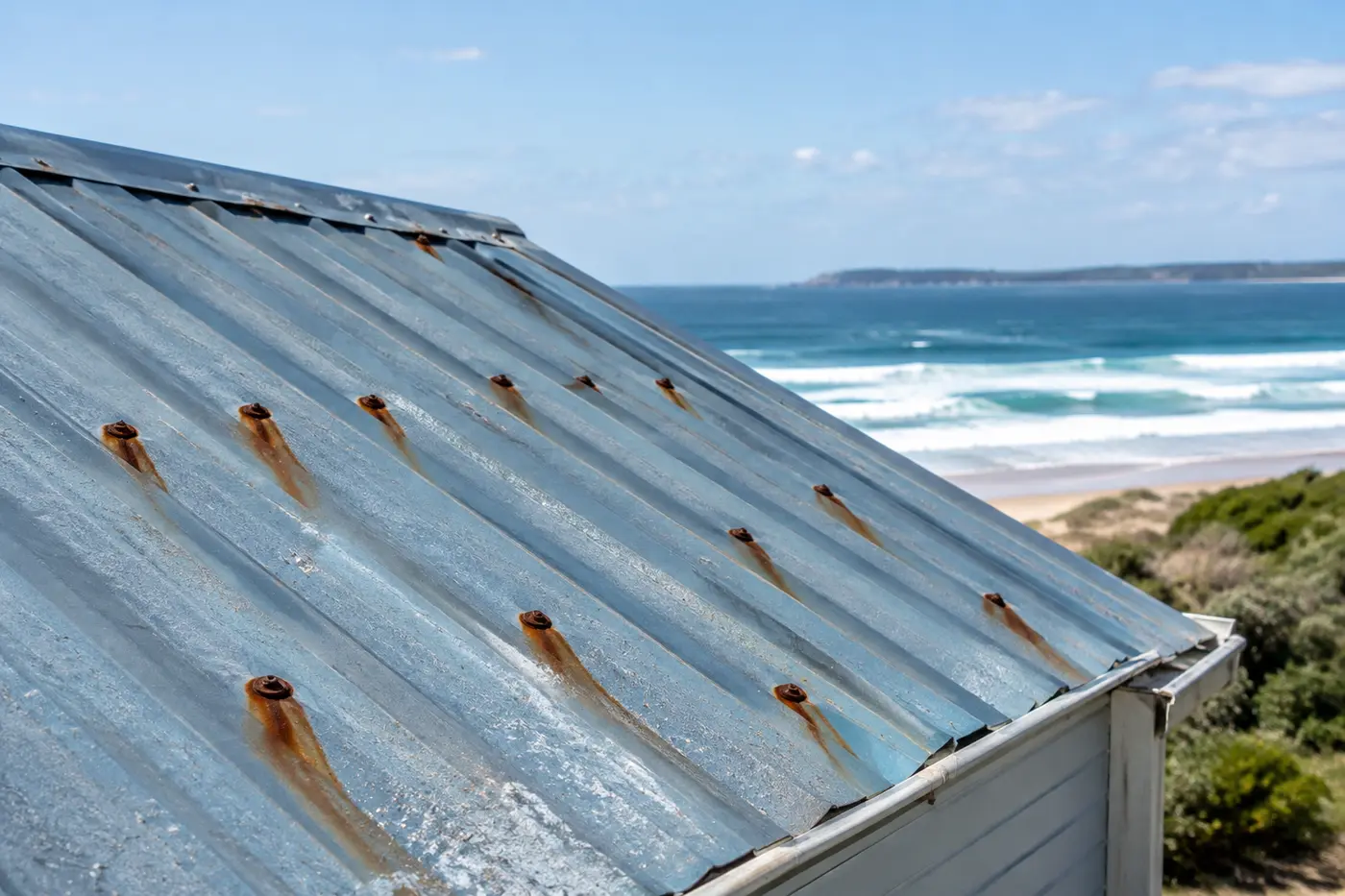
A few years after moving into a place at Culburra Beach, a lot of owners notice the same thing. The roof looks fine from the street, but up close there are orange freckles around the screw heads, a chalky bloom along the bottom of the sheets and a gutter that has started to weep at the joins. Nothing has fallen apart yet. The roof is showing coastal roof corrosion, and it moves faster than most people expect.
We work on tile and metal roofs from Nowra out to the beaches, and the difference between a roof a few streets back from the surf and one in town is obvious once you have seen enough of them. This post covers what salt air actually does to a roof, where to look for it, and what you can do about it before it turns into a leak.
Salt does most of its damage where the rain never reaches
This one surprises people. The parts of a coastal roof that get hit hardest by weather usually hold up best. Rain washes salt off the open sheets every time it falls, so the exposed surfaces stay fairly clean.
The trouble sits in the sheltered spots. Salt spray settles there, the rain never rinses it off, and morning dew turns it into a thin salty film that stays damp for hours. Then it dries, more salt lands, and the cycle repeats. That damp and dry routine is what eats through paint and metal coatings.
On the homes we look at, the worst corrosion tends to turn up in a handful of places:
- the underside of gutters and the back of fascia
- sheet laps, where two sheets overlap
- under eaves and patio roofs that face away from the weather
- around screw heads and their washers
- cut ends of sheets, flashings and valley iron
If you only ever look at the roof from the lawn, you will miss most of these.
On metal roofs it nearly always starts small
On Colorbond and Zincalume roofs, corrosion rarely starts in the middle of a sheet. It starts at a weak point and spreads.
Screws go first
The fasteners are often the first thing to rust on a coastal roof. A rusty screw head is mostly cosmetic at first, but the rubber washer underneath also breaks down in the sun, and once it does, water can track down the screw hole. Rust from the screw then stains and attacks the sheet around it. Replacing tired screws with fresh ones that suit the conditions is one of the cheapest repairs on a metal roof, and one of the most worthwhile.
Leftover filings leave rust spots
When sheets are cut or drilled on the roof, tiny metal filings called swarf land on the surface. If nobody sweeps them off, they rust within weeks and leave little orange dots that can damage the coating underneath. Near the coast, that happens faster. It is a sign of a careless install rather than a bad product, and the filings are worth brushing off as soon as you spot them.
Some metals do not get along
Water running off copper pipes or lead flashing onto Zincalume, for example, can corrode the sheet below. Salt makes this reaction worse because salty water carries electrical current far better than rainwater. If you have an old flue, an air conditioner or a solar mount sitting on the roof, check what is touching what.
If you are choosing a finish for a new roof by the water, we have covered the trade-offs in our Zincalume and Colorbond comparison. For beachfront homes, ask your supplier which product the manufacturer recommends for your exact distance from the surf, because the warranty depends on it.
Tile roofs are tougher, but their metal parts still suffer
Concrete and terracotta tiles do not rust, so tile roofs near the beach generally cope better than metal. The weak points are the metal parts and the joints.
Valley irons, the metal channels where two roof slopes meet, carry a lot of water and collect leaf litter and salt. On older homes these are often plain galvanised steel, and on the coast they can rust through well before the tiles show their age. Flashings around chimneys and walls behave the same way. The mortar holding the ridge caps also takes a beating from wind and spray, and once the pointing cracks, salty water gets into the bedding underneath.
Concrete tiles lose their surface coating over time, which leaves them more porous. That is not a salt problem as such, but it means moss, lichen and grime hold moisture against the tile for longer.
You can spot most of the warning signs from the ground
You do not need to climb up to see most of these. A pair of binoculars and a slow walk around the house will show a lot. Look for:
- orange or brown streaks running down from screw heads
- paint that has gone chalky, flaky or bubbly, especially along sheet edges
- white powdery deposits on Zincalume, an early sign the coating is breaking down
- rust stains at gutter joins, or pinholes you can see light through
- water stains on ceilings near external walls or under valleys
Surface rust on a few screws is a maintenance job. Rust you can push a screwdriver into, or holes in the sheet, means that section needs replacing. If you are not sure which one you are looking at, that is exactly what we check on a metal roof repair visit, and we will tell you plainly if a patch or a few new sheets will do.
You cannot stop salt air, but you can slow it right down
Wash the sheltered areas. Hosing fresh water over the parts the rain misses, like the underside of gutters, eaves and patio roofs, does more than most products sold for the job. Use a garden hose, not a pressure washer, which can strip coatings and push water under the laps. The closer you live to the surf, the more often it is worth doing.
Keep gutters clear. Leaves and salt sitting in a gutter make a wet, salty mulch that eats the metal from the inside. Clean gutters drain and dry out.
Replace fasteners before they fail. A screw that is rusting today is a leak in a few years. Swapping them out is quick and inexpensive next to the cost of a new sheet.
Treat rust early. Small patches of surface rust can be cleaned back, primed and painted. Painting straight over rust without treating it just hides it for a season.
Use matching materials for repairs. When a section is replaced, the new flashing, screws and sheets should all suit coastal conditions and be compatible with each other. Mismatched parts are a common reason a repair rusts out sooner than the rest of the roof.
The closer to the water, the more often your roof needs a look
Homes right on the coast, such as those around Culburra Beach and Shoalhaven Heads, take the heaviest salt load, especially on the side facing the water and the prevailing wind. Places along the river and estuary get a milder version of the same thing. Further inland, around West Nowra or Cambewarra Village, salt is much less of a factor and the usual culprits are leaf litter, age and storm damage.
The practical point is that a roof by the beach needs checking more often than the same roof in town. Left alone it will wear out sooner, but with regular attention it can still give good service.
Find out if it is a quick fix or a bigger job
If you have spotted rust, chalky paint or stained gutters and want to know what you are dealing with, we can take a look. Ryan Bruce leads our team, we have more than 10 years of roofing experience behind the work, and we are fully licensed and insured. We will explain what we find in plain English and give you a free written quote for any rust and corrosion repairs on your metal roof.
Common questions about salt air and roofs
Does salt air damage Colorbond roofs?
It can, mainly in sheltered areas the rain does not wash and around screws and cut edges. The standard product has limits on how close to breaking surf it can be used. Very exposed homes may need a range made for severe coastal conditions, so check the manufacturer’s guidance before you buy.
Is Zincalume a good choice near the beach?
Plenty of coastal homes have Zincalume roofs that perform well. It is sensitive to runoff from copper and lead, and to salt sitting in sheltered spots, so detailing matters. Right on the beachfront, check the manufacturer’s recommendation for your location first.
How do I clean salt off my roof?
Rinse with fresh water from a garden hose, focusing on the areas the rain does not reach. Avoid pressure washers on metal roofs, as they can damage the coating and drive water under the sheet laps. If you cannot reach those areas safely from the ground, leave it to someone with the right safety gear.
Can I just paint over rust on my roof?
Not if you want it to last. Rust has to be cleaned back to sound metal and primed before painting, otherwise it keeps spreading under the new paint. If it has eaten through the sheet, paint will not fix it and that section needs replacing.
Do tile roofs get salt damage?
The tiles themselves cope well. The metal valleys, flashings and fixings on a tile roof can still rust, and ridge cap pointing can crack, so those are the parts to watch on a coastal tile roof.
When does a rusty roof need replacing instead of repairing?
If the rust is limited to screws, small patches or a few sheets, repairs usually make sense. When corrosion has gone right through sheets across large areas of the roof, patching becomes poor value and replacement is the honest answer. We will tell you which one you have after an inspection.